Description
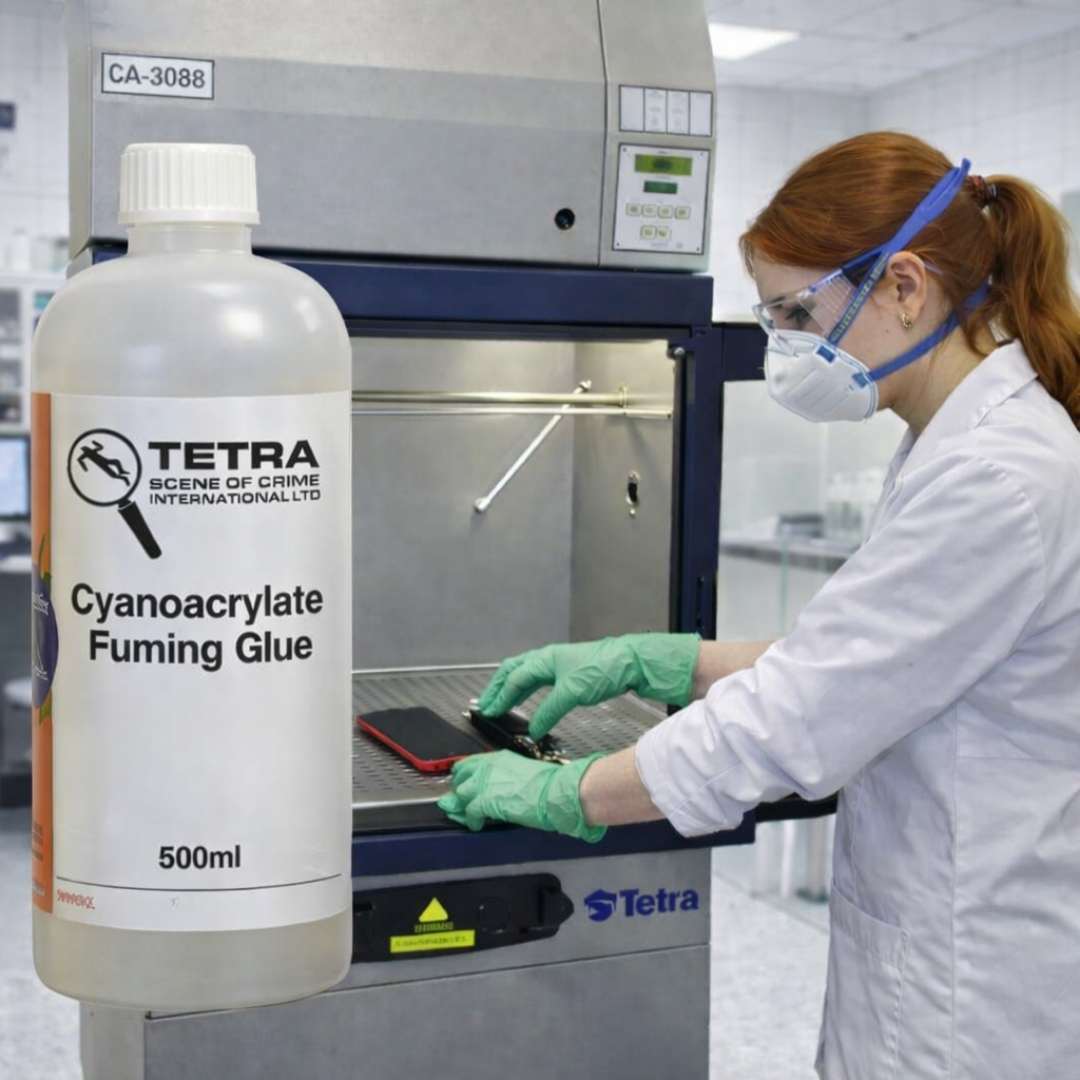
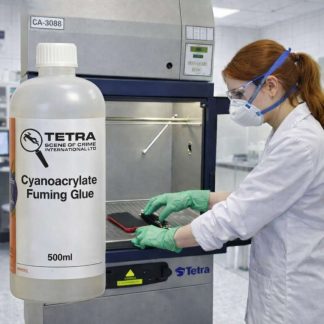
Using cyanoacrylates (e.g., “Super Glue”) found in various instant bonding glues to develop latent prints on objects has been quite successful over the past few years. Upon placing the evidence and the glue product in an superglue chamber, the fumes from these liquid adhesives react with the residues in latent prints to a hard, white visible impressions. The resulting visible prints can be photographed and processed with powders or chemicals.
500 ml
Helpful Information:
Cyanoacrylate (Superglue) Fingerprint Fuming: What It Is and How It Works
What Is Cyanoacrylate?
Cyanoacrylate is a fast-acting adhesive compound commonly known as superglue. In forensic science, cyanoacrylate is widely used in a controlled vapor form to develop latent fingerprints on non-porous surfaces such as plastic, metal, glass, and finished wood.
The process is commonly referred to as cyanoacrylate fuming or superglue fuming and is a standard technique within modern forensic investigations.
Cyanoacrylate in Forensic Science
In the context of forensic science, cyanoacrylate fuming is used to make otherwise invisible fingerprints visible for documentation and analysis.
When cyanoacrylate is heated in a controlled environment, it releases vapors that interact with residues left behind in fingerprints—such as amino acids, oils, and moisture—causing a white polymer to form along the ridge patterns.
This reaction preserves the fingerprint structure and enhances contrast, allowing examiners to photograph and further analyze the print.
Why Cyanoacrylate Is Used for Fingerprint Fuming
Cyanoacrylate fuming is valued in forensic work because it:
-
Develops latent fingerprints without direct contact
-
Works well on non-porous and semi-porous surfaces
-
Creates a durable, stable fingerprint impression
-
Allows for secondary enhancement techniques (e.g., dye staining)
-
Reduces the risk of smearing or damaging evidence
Because of its effectiveness and reliability, it is routinely used in crime laboratories worldwide.
Surfaces Commonly Examined Using Cyanoacrylate Fuming
Cyanoacrylate fuming is most effective on:
-
Glass and mirrors
-
Plastics and polymers
-
Metals and coated surfaces
-
Glossy painted or lacquered materials
Porous surfaces such as untreated paper or fabric typically require alternative fingerprint development methods.
Reviews
There are no reviews yet.