Description
What it’s used for in forensics
1. Bullet trajectory reconstruction
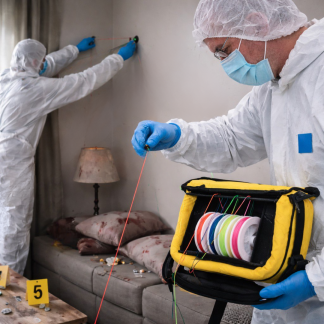
Investigators place lasers or laser rods into bullet holes (in walls, vehicles, glass, or bodies) to project a straight line showing the bullet’s path through space.
2. Determining shooter position
By extending the laser backward, investigators can estimate:
3. Corroborating or disproving statements
Laser trajectory analysis can confirm or contradict:
4. Crime scene documentation
The projected laser path can be:
5. Courtroom demonstration
Lasers provide a clear, visual explanation of bullet paths, making complex spatial evidence easier for judges and juries to understand.
What a typical laser trajectory kit includes
-
Adjustable laser pointers or laser rods
-
Rods that fit into bullet holes or defects
-
Mounts and angle measurement tools
-
Scales or reference markers
Important limitations
Because of this, laser trajectory analysis is usually combined with ballistics, scene analysis, and medical examiner findings.
If you want, I can also explain how this differs from string trajectory methods or how it’s used specifically in autopsy reconstruction.
.
Contents:
Four large diameter connecting rods, suitable for use on holes produced by weapons down to 32 caliber. Can be connected in succession or used alone.
Four sets of spacer cones and O-rings. Spacer cones are used to centre the rods within each bullet hole, O-rings will keep the rods in place without slipping.
Tripod mount with centred connecting holes to keep the rods and laser co-aligned, can be used with either the rods or the BP-1 Trajectory Laser for setting known angles. Angle finder used to measure the results for documentation. Will either fit on the rod or can be attached to the tripod mount with adhesive wax trajectory laser, guaranteed to be centre aligned from the factory.



Reviews
There are no reviews yet.